Feeds:
Posts
Comments

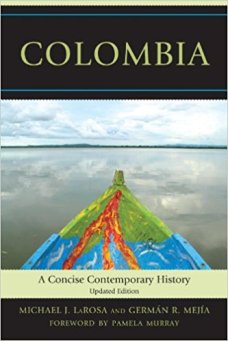
51f38SlZnUL._SX331_BO1,204,203,200_Across ten chapters organized thematically rather than chronologically, Michael J. LaRosa and German R. Mejía present this fine English-language history of Colombia in accessible prose that only occasionally belies that they were writing or thinking initially in Spanish before making this considerable gift to the English reading public.

The line-up of chapter titles arguably serves as LaRosa’s and Mejía’s first promise that their history will not weep over a fragmented and violent nation, but rather will sketch the contours of a nation seeking unity, nourished by a certain dynamism, and eager—or perhaps more often merely destined—to find its place in the world:

  • ‘Origins’
  • ‘The Colombian Nations’
  • ‘The Dynamics of a Political Community’
  • ‘The Cadence of Unity’
  • ‘Conflict’
  • ‘Economic Unity’
  • ‘A Common Space’
  • ‘Cultural Dynamism’
  • ‘Daily Life’
  • ‘Colombia and the World’

The book’s first chapter (‘Origins’) establishes the case for autonomy and then independence from Spain on the awkward fact that Spanish plans for that European nation’s ‘American’ colonies would always leave the ‘creoles’ at a disadvantage over peninsular interests. The detail that this history begins with post-Columbian political reorganization rather than the pre-Columbian ‘given’ that the Spanish conquerers encountered is perhaps symptomatic of the concise nature of the work. It is also programmatic of history and of this particular narrative that ‘Colombia’ was born in blood and contest, a genesis that wants to extend its hegemony—but in LaRosa’s and Mejía’s telling, does not finally succeed—from the beginning through to the end of the nation’s story. In this North American reader’s opinion, the authors make the eventual Colombian state’s post-Encounter pre-history understandable in broad brush and via analogies with a North American historical experience that is more familiar to the book’s English readership. Continue Reading »
Los días oscuros antes de la destrucción de Israel por el poder de Asiria, dejaron a pocos intactos. Incluso los niños.

Luego el Señor me dijo: «Haz un letrero grande y escribe con claridad el siguiente nombre: Maher-salal-has-baz[a]». Les pedí al sacerdote Urías y a Zacarías, hijo de Jeberequías, ambos conocidos como hombres honrados, que fueran testigos de lo que yo hacía.

Después me acosté con mi esposa y ella quedó embarazada, y dio a luz un hijo. Y el Señor me dijo: «Ponle por nombre Maher-salal-has-baz. Pues antes de que este hijo tenga edad suficiente para decir “papá” o “mamá”, el rey de Asiria se llevará la abundancia de Damasco y las riquezas de Samaria». (Isaías 8:1-4).

Cuando el profeta fija este sobrenombre sombrío a su bebé, él señala la inminente destrucción de los vecinos amenazantes de Israel. El nombre significa  ‘Pronto al saquéo, rápido al botín ’. Continue Reading »

Sería erróneo decir que las estructuras y patrones de culto y liturgia, carecen de valor en el legado de un profeta bíblico como en el caso de Isaías. De hecho, algunas de las expresiones más agitadas de parte del profeta respecto a la redención de YHWH de Israel prometen la  impactante integración al culto de los extranjeros y los mutilados, personajes que fueron convencionalmente excluidos.

Sin embargo, en el párrafo final del libro, YHWH parece completamente indiferente a digamos, un templo construido para su reposo. Él podría hacer por sí mismo mil de estos si el capricho lo empujara.

Jehová ha dicho: «El cielo es mi trono y la tierra el estrado de mis pies. ¿Dónde está la casa que me habréis de edificar? ¿Dónde el lugar de mi reposo?Mi mano hizo todas estas cosas, así todas ellas llegaron a ser», dice Jehová. «Pero yo miraré a aquel que es pobre y humilde de espíritu y que tiembla a mi palabra.» (Isaías 66:1–2 RVR95)

Cada vez que Isaías asalta la religión y su observancia litúrgica, lo hace por una de dos razones. O bien el profeta declara inútil el desempeño ritual en ausencia de una ética digna del pueblo de YHWH. O, por el contrario, está elevando algo de  mayor valor que la observancia cultual, por buena que ésta es. Continue Reading »

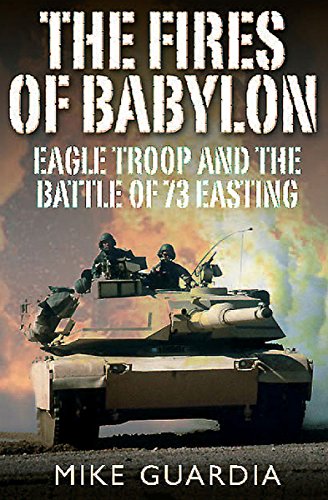
In a political era when scandalously few of the United States’ political leaders have beenshaped by military service, this b51K4gjfgdKLook provides a fascinating look at a formative moment in the career of HR McMaster, who as this reviewer sets pen to paper serves as the country’s National Security Advisor.
The brief survey of an armored battle that takes pride of place in a world that sees few such large-scale engagements of tanks tells as well the satisfying story of the U.S. Military’s improbable feat of transformation from post-Vietnam malaise through to the disciplined, strategically minded force that destroyed Saddam Hussein’s forces in the First Gulf War (1990-91).

Guardia’s Fires of Babylon chronicles the U.S. Army’s pivot from an anti-Soviet blocking mission that had lost its relevance by the time the Berlin Wall crumbled to a highly fluid challenge from operating positions in Saudi Arabia, Kuwait, and eventually Iraq itself. It was commanders like McMaster (a Captain at the time of 73 Easting) who brought the discipline and savvy that produced overwhelming military success against an Iraqi force that was judged to be capable of kicking butt on the battlefield. In the end, only one butt got kicked in an epic slaughter that could have led to the removal of Saddam but for the political considerations that led the first President Bush to pull up short. Continue Reading »

Isaías no es tanto el heraldo de comienzos poco probables, como él es el profeta de re-ediciones poco prometedoras.

Su interés idiosincrásico no es la historia de los orígenes, pero más bien es la anticipación de las cosas muertas que surgen en silencio a la vida. En el capítulo 11 del libro que lleva su nombre, el profeta asume la destrucción de la monarquía davídica. Habiendo hecho esto, este oráculo convincente se remonta a Isaí, el padre de David, el antecedente pastoral de reyes y reinos. Es como si un nuevo comienzo requiriera una retirada radical al momento antes de que la larga trayectoria de la decepción israelita en sus reyes se hubiera disparado sobre su arco tortuoso.

Y brotará un retoño del tronco de Isaí, y un vástago de sus raíces dará fruto. Y reposará sobre El el Espíritu del Señor, espíritu de sabiduría y de inteligencia, espíritu de consejo y de poder, espíritu de conocimiento y de temor del Señor. Se deleitará en el temor del Señor, y no juzgará por lo que vean sus ojos, ni sentenciará por lo que oigan sus oídos; sino que juzgará al pobre con justicia, y fallará con equidad por los afligidos de la tierra; herirá la tierra con la vara de su boca, y con el soplo de sus labios matará al impío. La justicia será ceñidor de sus lomos, y la fidelidad ceñidor de su cintura. (Isaías 11:1-5 LBLA).


Este vástago sin nombre de la casa de Isaí emerge de un árbol muerto, cortado hasta el  tocón y dejado para pudrirse en medio del bosque de reinos que no funcionaron. Continue Reading »

La historia, la genealogía y la confesión pueden ser falsificadas.

En su camino hacia una promesa profundamente conmovedora de  ‘nuevas cosas’ que serán a la vez redentoras y fáciles de recibir, el capítulo 48 del libro de Isaías profundiza en la pretensión de Israel/Judá. Aquí vemos  la lógica de  ‘refinar’  a este pueblo ‘en el horno de la aflicción’, ya que desde la perspectiva de Isaías sólo una nación humilde puede recibir el futuro de YHWH. E Israel no será humilde hasta que sea humillada.

Escuchen esto ustedes, los de la familia de Jacob, descendientes de Judá, que llevan el nombre de Israel; que juran en el nombre del Señor, e invocan al Dios de Israel, pero no con sinceridad ni justicia. Ustedes que se llaman ciudadanos de la ciudad santa  y confían en el Dios de Israel, cuyo nombre es el Señor Todopoderoso. (Isaías 48:1-2).

El pasaje comienza como si caminara hacia una declaración heroica. La identidad histórica de Jacob conduce a la nación a adularse por el nombre de ‘Israel’. Y probablemente debemos imaginar el detalle genealógico de la procreación cuando leemos que Jacob vino ‘de aguas de Judá´. Todo este legado se complementa con las actividades actuales de ‘jurar (juramento), por el nombre de YHWH y confesar (confesando) al Dios de Israel ´. Continue Reading »

We often think of religious leaders as unable to change. We think they believe they know it all, have the answers already, cannot alter their presumably doctrinaire convictions.

So refreshing, then, this priestly cameo in one of Luke’s summary reports of growth in the early, Jerusalem-based Jesus Movement.

And the word of God continued to increase, and the number of the disciples multiplied greatly in Jerusalem, and a great many of the priests became obedient to the faith. (Acts 6:7 ESV)

Luke seems not to be going anywhere with this observation. He has no agenda on this front. There is no subsequent re-take on priestly influence at the core. After this, Jerusalem’s priests are largely left alone to live their lives unobserved. Continue Reading »

Even if one did not know that the discourse of Isaiah will pivot repeatedly on the Hebrew word אמן—used of faithfulness, reliability, truthful sturdiness, and belief—the italicized exclamation that follows might hint at the direction to come.

How the faithful (נאמן) city has become a whore, she who was full of justice!

Righteousness lodged in her, but now murderers. Your silver has become dross, your best wine mixed with water. Your princes are rebels and companions of thieves. Everyone loves a bribe and runs after gifts. They do not bring justice to the fatherless, and the widow’s cause does not come to them. (Isaiah 1:21–23 ESV)

The book’s prefatory first chapter, after all, serves like a thematically dense prelude to a theatrical work, much as a pit orchestra might touch on all the themes soon to be broached by the actors on the stage. It soberly teases the reader with topics that will shape the core of the book’s sustained argument. Nothing lies nearer to that core’s core than justice. Continue Reading »

Arguably my most self-absorbed acquisition this decade, I bought this mug for my wife.

She loves the humor (failing to see it as a statement of fact), but also appreciates how big and sturdy this mug is.41xci8IjqcL._AC_US320_QL65_

After a recent move,51i2LkUTNKL._AC_US320_QL65_ I’ve dropped ties, belts, shoes, and half-used cans of paint from my list of Things You Can Never Have Too Many Of.

However, I’m leaving bungee cords on there, especially after the recent arrival of this oddly conceived jar of the things. I mean, who buys bungees in a jar?

But it works and serves up a nice little compact container that now sits on the basement shelf ready to cough up the right-sized cord at a moment’s notice. The first moment arrived earlier today, when we realized both dog leashes are in a car that’s at the shop. A bungee serves nicely as an emergency dog leash (who knew?). Thanks to the Cartman Bungee Cords Assortment, we had just the right size for the job.