Feeds:
Posts
Comments

Jonathan Wilson’s intimate look at this most enigmatic artist is just the introduction a non-specialist like this reviewer needs for moving from a first encounter with Chagall’s work to a deeper understanding of his life and person. I suspect the veteran Chagall watcher will also find more than a little in Wilson’s pages that will enrich his understanding or throw fresh light on ambiguities that are worthy of further inspection.
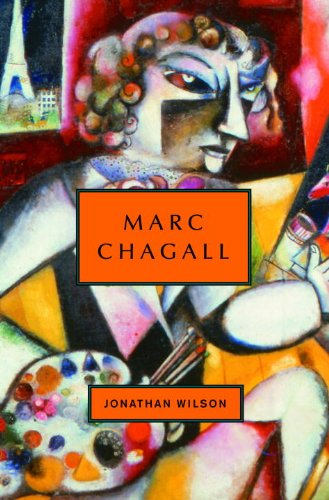
51Tg6-LCzQLWilson’s method is to follow Chagall around from city to city and lover to lover. Evidence for this is seen in the titles of the book’s seventeen chapters. All but three of them simply present the name of one of Chagall’s places or one of his women. So, for example, ‘1. Vitebsk, 2. St. Petersburg, 3. Paris, 4. Bella … 12. New York, 13. Virgina (Haggard), 14 Orgeval …’ The three exceptions (6. Yiddish Theater, 15. A Problem of Conscience, 17. Blessings) explore matters of deep thematic importance that lie close to the soul of Chagall and his art.

So does Wilson periodize Chagall’s life in helpful ways. We travel with an artist as he moves from context to context in a world where it seemed impossible for him to own any one of them completely or to deny any one finally. Chagall emerges as a conflicted human being, unable fully to rank the places and the people that have shaped him, unable to leave any place behind, certain to live simultaneously as Russian, as Jew, as Frenchman, as quasi-American, as on-again, off-again Zionist, as an artist who was himself never other than a work in progress. Continue Reading »

Easter is becoming a rough time for Christians in lands where Islam is the dominant religion. It’s likely to become still rougher, as this preeminent Christian holy day packs the elements that most enrage Islamist sensitivities into one dense cluster of hours.

A poignant and stirring pair of paragraphs closes today’s Wall Street Journal coverage of the pain and anger that follow upon this weekend’s double massacre in Egypt. Continue Reading »

I never blog about stuff like this.

But the reports and video coming out regarding a passenger’s forceful removal from an aircraft at Chicago’s O’Hare Airport yesterday have me incensed. Continue Reading »

Isaiah is not so much the herald of unlikely beginnings as he is the prophet of unpromising re-starts.

His signature is not the tale of origins, but rather the anticipation of dead things springing quietly to life. In chapter 11 of the book that bears Isaiah’s name, the prophet assumes the destruction of the Davidic monarchy. Having done so, this compelling oracle goes back to Jesse, the father of David, the shepherdly antecedent to kings and kingdoms. It is as though a fresh start requires a radical retreat to the moment before the long trajectory of Israelite disappointment in its kings had set off upon its tortuous arc.

There shall come forth a shoot from the stump of Jesse, and a branch from his roots shall bear fruit. And the Spirit of the Lord shall rest upon him, the Spirit of wisdom and understanding, the Spirit of counsel and might, the Spirit of knowledge and the fear of the Lord. And his delight shall be in the fear of the Lord. He shall not judge by what his eyes see, or decide disputes by what his ears hear, but with righteousness he shall judge the poor, and decide with equity for the meek of the earth; and he shall strike the earth with the rod of his mouth, and with the breath of his lips he shall kill the wicked. Righteousness shall be the belt of his waist, and faithfulness the belt of his loins. (Isaiah 11:1–5 ESV)

This unnamed scion of the house of Jesse emerges from a dead tree, cut down to stump and left to rot amid the leveled forest of kingdoms that did not pan out. Continue Reading »

Langham Partnership Vision Weekend

March 2017

I’ve had the privilege for nearly fifteen years of being a ‘fellow traveler’ with the people and mission of the Langham Partnership.

I’ve sometimes felt like an adoptive member of the family, sometimes a bit like odd Uncle Harry who turns up at holidays and bellows his opinions too loudly from a corner of the living room, sometimes a strategic collaboration partner, sometimes Langham’s very own Serial Party Crasher, and quite often the recipient of that beautiful surprise we call friendship. Along the way, I’ve come to love and admire the people and the mission of Langham.

Now I have no official authorization to coin the phrase ‘The Langham Tripod’. But old friends usually tolerate the liberties that old friends take, or at least overlook certain foibles. So I’m going to do it. Continue Reading »

The plethora of names in Isaiah 7.1-9 requires a complete reading if we are to make sense of it.

In the days of Ahaz the son of Jotham, son of Uzziah, king of Judah, Rezin the king of Syria and Pekah the son of Remaliah the king of Israel came up to Jerusalem to wage war against it, but could not yet mount an attack against it. When the house of David was told, ‘Syria is in league with Ephraim,’ the heart of Ahaz and the heart of his people shook as the trees of the forest shake before the wind.

And the Lord said to Isaiah, ‘Go out to meet Ahaz, you and Shear-jashub your son, at the end of the conduit of the upper pool on the highway to the Washer’s Field. And say to him, “Be careful, be quiet, do not fear, and do not let your heart be faint because of these two smoldering stumps of firebrands, at the fierce anger of Rezin and Syria and the son of Remaliah. Because Syria, with Ephraim and the son of Remaliah, has devised evil against you, saying, ‘Let us go up against Judah and terrify it, and let us conquer it for ourselves, and set up the son of Tabeel as king in the midst of it,’ thus says the Lord God: ‘It shall not stand, and it shall not come to pass. For the head of Syria is Damascus, and the head of Damascus is Rezin. And within sixty-five years Ephraim will be shattered from being a people. And the head of Ephraim is Samaria, and the head of Samaria is the son of Remaliah. If you are not firm in faith, you will not be firm at all.’”’ (Isaiah 7:1–9 ESV)

The manifest terror of Ahaz and his vulnerable Judahites is captured in the image of hearts shaking ‘as the trees of a forest shake before the wind’. The careful reader might sense in the prophet’s allusion to a wind (רוח) the barest of hints that another ‘wind’ (רוח in Isaiah and elsewhere refers often to YHWH’s ‘spirit’) also blows across Judah amid what can only be experienced as an existential crisis. It is the latter breeze that is capable of effecting the prophet’s bidding to calm down and refuse to panic, even as this divine rustling stands as well behind YHWH’s bold declaration that the machination of Judah’s enemies ‘shall not stand and shall not be’ (v. 7). Continue Reading »

It would be wrong to say that the structures and patterns of cult and liturgy lack value in the legacy of a biblical prophet like Isaiah. In fact, some of the prophet’s most stirring expressions of YHWH’s redemption of Israel promise the shocking inclusion into worship of people like foreigners and the badly mutilated, who were conventionally excluded.

Yet in the book’s final paragraph YHWH seems entirely unimpressed by, say, a temple constructed for his repose. He could make for himself a thousand of these if the whimsy struck him. Continue Reading »

repurposed: Isaiah 60

The brilliant tale of Judah’s national resurrection in the Book of Isaiah’s sixtieth chapter is populated with glimpses of the nations’ contribution to Jerusalem’s beautification.

It seems that distant nations streaming to glorified Zion carry with then not only Jerusalem’s long-lost children as these come finally home. As remote peoples ‘come to (Zion’s) light and kings to the brightness of (Zion’s) shining’, they also bring with them the richest product of their culture and economy. They import into the now glorified city the ‘abundance of the sea’ (המון ים) and the ‘wealth of the nations’ (חיל גוים), even the representative ‘glory of Lebanon’ (כבוד הלבנון). Continue Reading »

A veces un profeta sólo se alza sobre sus retóricas ‘patas traseras para rugir.’

Las siete preguntas retóricas del Libro de Isaías en su capítulo cincuenta y ocho parecen calificar como rugido profético. Continue Reading »

Un apodo puede ejercer más impacto en la vida de la persona que es llamada de esta nueva forma que, por medio de la utilización del nombre de pila.

Tu nombre puede ser Rafael, pero si los compañeros de cancha te llaman Chino, este último dice más acerca de su persona que su nombre de pila. Continue Reading »