Feeds:
Posts
Comments

Empires are so very vulnerable to hubris. It always gets them, eventually.

When YHWH whistles for the Assyrian bee to inflict his burning but redemptive sting upon Judah, which has earned for itself the title ‘a godless people’, Assyria fails to grasp the part about redemption.

Against a godless nation (Judah) I (YHWH) send him (Assyria), and against the people of my wrath I command him, to take spoil and seize plunder, and to tread them down like the mire of the streets. But he does not so intend, and his heart does not so think; but it is in his heart to destroy, and to cut off nations not a few. (Isaiah 10:6–7 ESV)

The distance between ‘to take spoil and plunder’ and ‘to tread (Judah) down like the mire of the streets’, on the one hand, and ‘to destroy and to cut off nations’ on the other may seem like a trifle leading only to a nuance. But for this text, it represents a world of difference between YHWH’s intention and  Assyria’s end-game. It manifests a distinction of purpose and of character that means everything. YHWH purposes (only…) to wound in order to heal. Assyria, the almost unchallengeable superpower of the moment, intends to exterminate.

If YHWH’s apparent surprise at Assyria’s severity raises ethical questions of its own about the divine comportment, that matter must await another day.

For now, it is Assyria’s imperial hubris that catches that eye.

For he says: ‘Are not my commanders all kings? Is not Calno like Carchemish? Is not Hamath like Arpad? Is not Samaria like Damascus? As my hand has reached to the kingdoms of the idols, whose carved images were greater than those of Jerusalem and Samaria, shall I not do to Jerusalem and her idols as I have done to Samaria and her images?’ (Isaiah 10:8–11 ESV)

Sure as the sun rises in the east and sets in the west, success persuades the powerful that the past predicts the future. It does not. The system is not so closed.

There is always cause for humility, not least the stalking about of unseen personalities, one of whom dares to suggest that the nations are before him like dust on a scale.

Assyria, as the text quotes that great nation’s inner thoughts here, expects that a certain set of answers to its arrogant barrage of rhetorical questions is obvious.

Are not my commanders all kings? Indeed!

Is not Calno not like Carchemish? Of course, my liege.

Is not Hamath like Arpad? Not a stroke of difference between them, my king.

Is not Samaria like Damascus? Without doubt.

Shall my hand not then take Jerusalem and her idols? Go for it and be glorious!

What the biblical text knows is that empire becomes both blind and forgetful to the reality that it is not alone on the field of greatness. Others become restless, and fidget for the moment when this self-absorbed pretender shall be put down.

And for Isaiah, a most important word remains yet to be spoken:

One of them is no idol.



Emmanuel!: Isaiah 8

Among the reasons for the notoriety that attaches to the Book of Isaiah figures its introduction of ‘Emmanuel’ (Hebrew: עמנו אל) as a name.

As with everything in this massive biblical work, it happens enigmatically. The more famous attachment of the name to a child yet to be born is preceded by the word’s appearance in a context of warfare, threat, and deliverance. No one would yet think of a child.

Because this people has refused the waters of Shiloah that flow gently, and rejoice over Rezin and the son of Remaliah,therefore, behold, the Lord is bringing up against them the waters of the River, mighty and many, the king of Assyria and all his glory. And it will rise over all its channels and go over all its banks, and it will sweep on into Judah, it will overflow and pass on, reaching even to the neck, and its outspread wings will fill the breadth of your land, O Immanuel. (Isaiah 8:6–8 ESV)

Violent, surging Assyria rises almost to the point of drowning vulnerable, flailing, ever-conspiratorial Judah. Its waters flood even to the neck, leaving no corner of the land untouched. Although there is one other interpretation that makes ‘Immanuel’ itself/himself the owner of ‘outspread wings’, the most common readings understand ‘O Immanuel’ as something of an exclamation. Either the outspreading wings of Assyria ‘will fill the bread of your land, O Immanuel’, where Immanuel is the lord of the violated land. Or ‘Emmanuel’ is a stand-alone cry of desperation: ‘… and (Assyria’s) outspread wings will fill the breadth of your (that is, Judah’s) land. O, Immanuel!’

In either case, ‘God with us’ remains an odd and puzzling expression that elicits the reader’s thoughtful curiosity about just what is going on here.

The text requests only the slightest pause before racing on to its second use of Emmanuel as a something close to a name. Again, children are neither seen nor heard.

Be broken, you peoples, and be shattered; give ear, all you far countries; strap on your armor and be shattered; strap on your armor and be shattered. Take counsel together, but it will come to nothing; speak a word, but it will not stand, for God is with us. (Isaiah 8:9–10 ESV)

The doomed collusion of two of Judah’s near neighbors (Syria and Ephraim, 7.5-7) is heard here by way of echo. Although ‘you peoples’ and ‘all you far countries’ likely includes also Assyria and even other nations, it begins closer to home with Judah’s plotting neighbors Syria and Ephraim.

Judahite desperation in the face of the Assyrian onslaught a few verses earlier now fades before a confident message of defeat to nations that would dare come against her. If ‘Emmanuel’ functioned as a quasi-name in verse 8, its mystery is drawn out still further here, where the word provides the reason for which Judah will not fall to the dark designs of well-armed peoples and nations.

‘Emmanuel’—whatever at this point the odd juxtaposition Hebrew עמנו (‘with us’) and אל (‘God’) can mean—will not allow the final destruction of his land and his people.

But where are the children?

The sad descriptions of YHWH’s people in their darkest moments serve to illuminate what YHWH wants for and from those people when health is restored.

The text of the Bible’s Book of Isaiah probes at matters of knowing and understanding, sometimes from the dark side of its absence, at others from the side of health and blessing.

In the book’s programmatic first chapter, Judah/Israel is contrasted with farm animals when it comes to knowing and understanding.

The ox knows its owner, and the donkey its master’s crib, but Israel does not know, my people do not understand. (Isaiah 1:3 ESV)

Mere habit, the raw animal instinct for having physical needs met, is enough for ox and donkey to claim the advantage over what Isaiah describes as a willfully imperceptive people. The Hebrew words at play are ידע and בין. If the reader will tolerate a cheap pun, Isaiah will make hay with these words as the book presses his argument forward.

Isaiah underscores the extremity of Judah’s imperception by choosing not to attach the expected direct object to each of these verbs. It is not that they do not know this, not understand that. Tragically, they neither know nor understand at all.

In the book’s unique ordering of events, the infamous prophetic commissioning of the prophet does not occur until certain things have first been placed on record. In chapter six, finally, Isaiah meets ‘the King’ in a temple vision. He is, he says, undone by the sight. Soon the severe mercy of Isaiah’s prophetic calling takes shape. It must have seemed all severity and no mercy.

And I heard the voice of the Lord saying, ‘Whom shall I send, and who will go for us?’ Then I said, ‘Here I am! Send me.’ And he said, ‘Go, and say to this people: “Keep on hearing, but do not understand; keep on seeing, but do not perceive.”’ (Isaiah 6:8–9 ESV)

The book will soon make clear that this savage scraping of the barrel’s perceptive bottom has redemptive ends. Israel will re-learn to see, to hear, to know, to understand. First, though, she must be led to the awful extreme of her self-chosen logic. She must experience the blunt force of true blindness, of genuine deafness.

The words again are ידע and ביןtheir order reversed this time. Israel/Judah must stop knowing and seeing so that she can—in time and by way of the Lord’s mercy and justice—learn again how to know, how to understand.

One can imagine a people where such knowledge and understanding lie at character’s core. A community in which seeing and hearing produce their full perceptive fruit by leading their subjects to deeply accurate and empathetic engagement with each other and with their world.

How the heart longs to belong to such a people, to stand in its middle—surrounded by the wise, the just, the merry—with knowledge and understanding.

If a book like the biblical Isaiah can rightly be considered inexhaustible, the claim pivots in part upon the sheer poetic nuance of its language.

The book’s third chapter fiercely denounces a leaderless people. Those who have not abdicated entirely the burden of leadership govern like children. Indeed the line after line of severe dissection of Judah’s body politic is almost too much to bear in the wake of a cartoonish electoral season when childishness became a political virtue.

Yet in contrast the prophet himself sustains a very adult command of his language.

Two conventional verbs come into play in the twelfth verse. I have italicized and underlined them, and italicized the words immediately surrounding.

My people—infants are their oppressors, and women rule over them. O my people, your guides mislead you and they have swallowed up the course of your paths. (Isaiah 3:12 ESV)

English translators, when they note the lyrical play, are forced by their target language to drop it from their hands. But a brief foray into the Hebrew text is a tool for recovery.

The verb here rendered guides is given the form of a noun. It is the Hebrew אשרa word that certainly does mean guide. But that meaning is only derivative. The action at its heart is a making straight, a keeping true, a straightening out. This is what guides are meant to do. They conduct those they lead along a course that leads them to a destination they’d be hard pressed to find on their own, efficiently and without detour. In the essence of things, they are path-straighteners. Isaiah notes their presence here, among a surrounding thicket of hapless leaders.

Yet these ‘guides’ do precisely that which one hires a guide in order to avoid. They make Judah wander. They put the people on a wrong course. They lead them astray.

Hebrew תעה is a conventional and therefore familiar word for this kind of action. You might expect it of a trickster, of a bandit well prepared in ambush, even of one’s wily enemy. But never of a guide.

Never of a path-straightener.

Isaiah returns to this very theme in the book’s ninth chapter.

… for those who guide this people have been leading them astray, and those who are guided by them are swallowed up. (Isaiah 9:16 ESV)

It is in these quiet juxtapositions of two conventional words that Isaiah’s rhetoric achieves its incomparable and enduring force. Presumably, it is here too that a remnant in Judah heard a persuasive voice and took measures to repent, to return, to come back onto a track that promised future instead of ashes. It is here in the small turn of a phrase, in the knowing juxtaposition of two common words to express an uncommon truth, that the book manifests some of the beauty that explains its survival, indeed its inexhaustible appeal.

full of it: Isaiah 2

The prophets poke at the sanctimony that assumes material blessing is YHWH’s endorsement. To be rich is to be good, people too easily assume. Isaiah, among others of his peers, will have none of this moral non sequitur.

For you have rejected your people, the house of Jacob, because they are full of things from the east and of fortune-tellers like the Philistines, and they strike hands with the children of foreigners. Their land is filled with silver and gold, and there is no end to their treasures; their land is filled with horses, and there is no end to their chariots. Their land is filled with idols; they bow down to the work of their hands, to what their own fingers have made. (Isaiah 2:6–8 ESV)

The irony—with Isaiah, there is always irony—pivots upon the Hebrew verb מלא, ‘to be full’. The prophet peppers his denunciation of false religion with this verb as though there’s no tomorrow.

The first and the last of the italicized מלא-phrases point to the lazy amplitude of their religion. Their very piety is an act of wandering, their religiosity a rejection of the exclusive Israelite God who has named himself to be unlike all others. The middle two italicized phrases refer to their wealth.

They are not good, because rich. They are, at the same time, very bad and very rich.

Idolatry, for the prophets, is not open-mindedness, not sophistication, not the cologne of the worldly-wise. It is treason, rebellion, the spiritual equivalent of getting stupidly hot and horny with a neighbor’s hungry wife. There is nothing good in it.

It is possible to gild it with gold, to ornament it with silver. Yet it remains the pathway to a world of eventual hurt.

Riches, declares the text, are not God’s endorsement. Sometimes wealth is just wealth, the shiny trinkets of the doomed.

To read Peter FitzSimon’s Gallipoli is to realize how great an evening it would be to have the man in front of a crackling fire in your living room, telling a good tale.

For it is the telling of a tale that FitzSimon promises us, a tale of how Australia ‘became a nation’ in the wrenching experiencing of bleeding for the British Empire on the hills of the Turkish coast.

519n8gv6zalFitzSimons puts a lot of himself in this story, not always a promising approach for a history writer. Yet this manages to illuminate rather than obscure the Gallipoli narrative. The author’s full-disclosure explanation of how his own understanding of the battle has changed gives the non-Australian reader a glimpse into the various ways in which that antiopodean nation itself has moved through various stages of engagement with one of its defining moments.
There is little to nothing good to say about a battle of this ferocity, one that concluded with surviving Anzac forces withdrawing to the sea under cover of darkness. But one can at least tell the awful story well. FitzSimons manages to write in—to speak in, for the reader can almost hear his voice—Australian, not a generic academic English.

The result is winsome, savage, feisty (for what is an Australian without a little feist?), and accessible. One emerges from reading this book made wiser not only about the flawed execution of what might otherwise have represented a victorious thrust by the Allied forces into the belly of the Turkish ‘sick man of Europe’, but also more intelligent about how Australian soldiers fought for the mother country’s Empire but died for Australia.

FitzSimons recognizes that many have told the Gallipoli story before him. His contribution is to write, one hundred years on, for Australians and friends of Australians like this reader, several generations hence, when a bit of cool reflection can both enrich and temper our understanding of the passions, ambitions, stupidities, and grit that produced Gallipoli.

A century is long enough for a certain empathy with the enemy of one’s forebears to develop in a way that does not trivialize the complex developments that led a country to war on a land whose name they barely knew. FitzSimons ably captures the privilege of this retrospective distance, not least by recording a recent re-encounter of Turkish and Anzac veterans on this very savage and sacred soil, and by resurrecting Mustafa Kemal’s generous words, penned in 1934:

Those heroes that shed their blood and lost their lives … You are now lying in the soil of a friendly country. Therefore rest in peace. There is no difference between the Johnnies and the Mehmets to us where they lie side by side now here in this country of ours … you, the mothers, who sent their sons from faraway countries wipe away your tears; your sons are now lying in our bosom and are in peace. After having lost their lives on this land they have become our sons as well.

Has it really been a century?

Peter FitzSimon’s fine and well-researched retelling makes it seem just yesterday.

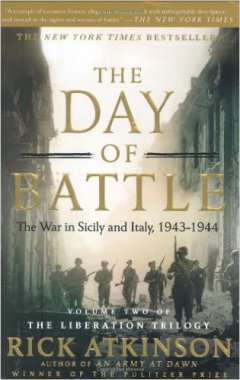
One wonders how the course of an epic war takes shape in the remembering mind. It is so easy to move to Normandy and the push across Europe towards Berlin. Yet Normandy and the reconquest of Europe came late in the war and were impossible without the unsung precursors. Like the invasion of Sicily and the hard slog up the Italian boot at a time when it was still possible to underestimate the enemy and, later, convenient to forget places like Anzio and Montecassino.

51kz5col-nl-_sx313_bo1204203200_In The Day of Battle, as elsewhere, Atkinson’s writing is not only fueled by the very best research. It also goes down smoothly as such a tale can.
The struggle that had begun in September 1939 was more than half over; yet if both commanders and commanded intuited that they were nearer the end than the beginning, they also sensed that less than half the butcher’s bill had been paid in a bloodletting that ultimately would claim sixty million lives: one life every three seconds for six years. They also knew that if the Allied powers—led by the United States, Britain, and the Soviet Union—now possessed the strategic initiative, the Axis powers of Germany, Italy, and Japan still held the real estate, including six thousand miles of European coastline and the entire western littoral of Asia.

Atkinson exegetes the butcher’s bill as few other military historians can.

In the little Pennsylvania town where this reviewer grew up, twenty-two names adorn the WWII memorial in the main cemetery. Two of these fell in Italy. Curiously, both were women: Carrie Sheetz, a nurse whose station was bombed by a rogue German fighter trying to escape pursuing allied planes at Anzio; and a certain Josephine Strohecker, who perished in Naples.

Atkinson provides a context for understanding such unsought sacrifice on the part of so many citizen soldiers.

This second entry to the Liberation Trilogy is a gift to those who remember the unsung fallen.

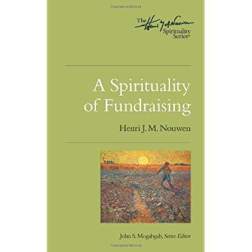
Henri Nouwen’s A Spirituality of Fundraising is a book I need to read again every year in order to keep my bearings.

415qui41ql-_ac_us436_ql65_My own battle with fundraising has seen some success and some notable failure. I was raised to believe that a decent person never asked anyone for money. Nouwen’s little book turns that idea upside down.

Or, better said, rightside up.

For Nouwen, asking people to become generous and even sacrificial stewards is offering those people the gift of conversion. He means this in the deepest, process-oriented, open sense of the word. Seen this way, it is a service rendered. Ministry extended. I need this.

Nouwen starts strong:

Fundraising is proclaiming what we believe in such a way that we offer other people an opportunity to participate with us in our vision and mission. Fundraising is precisely the opposite of begging. When we seek to raise funds we are not saying, “Please, could you help us out because lately it’s been hard.” Rather, we are declaring, “We have a vision that is amazing and exciting. We are inviting you to invest yourself through the resources that God has given you—your energy, your prayers, and your money—in this work to which God has called us.” Our invitation is clear and confident because we trust that our vision and mission are like “trees planted by streams of water, which yield their fruit in its season, and their leaves do not wither” (Ps. 1:3).

A winsome, God-fueled lightness of spirit pervades Nouwen’s reflection on fundraising, a light-heartedness that is seldom evidenced when this subject is on the table. We are freed, in the best rather than the self-serving sense of the phrase, to be free as we seek funding.

Indeed, Nouwen writes about such in connection with our ultimate security:

If our security is totally in God, then we are free to ask for money. Only when we are free from money can we ask freely for others to give it. This is the conversion to which fundraising as ministry call us.

So it is not only the person receiving our request, but we ourselves who encounter the opportunity of conversion as we go about this work.

I have grown weary of fundraising technique. My soul longs for a gospel-grounded understanding of this otherwise distasteful task.

Nouwen provides it in A Spirituality of Fundraising, this reviewer’s annual reading on the topic.

I had often heard of ‘Ernie Pyle’ from people who had been around to read his newspaper columns during ‘The War’ and—more often—from those whose parents had done so. But it was not until a solemn stroll through Honolulu’s National Memorial Cemetery of the Pacific brought me unexpectedly upon Pyle’s gravesite that he became a real human being to me. Ironically, for me he was humanized in his death. It is a sentiment that Pyle might have been expected to appreciate, for he humanized the American fighting man and woman precisely in their deepest extremis.51stormosil-_sx312_bo1204203200_

I immediately ordered this remarkable collection of Pyle’s columns, filed from a very mobile front as it made its way across Europe and towards Berlin.

It took a bit of time for Pyle’s writing to grow on me. His vocabulary, his pacing come—after all—from a different generation’s English. But grow on me it did.

By all accounts a complex man and by some accounts a troubled one, Pyle shines no light in these dispatches on himself. His singular focus is on the American GI and sailor. The title of this compilation might suggest a romantic touch. Yet romance is not what Pyle brought to war, and certainly not to his supremely empathetic picture of the American warrior in an epic conflict that not one of them had invited to interrupt his life.

I am tempted to say that every American school child should be required to read this book.

But that will never happen, and is hardly worth the words.

The good news is that some of us, more often than not those who have slowly grown to appreciate the citizen soldier with all his warts, will pick up and read this extraordinary collection of journalistic snapshots. Some of us will pause quietly at the end of one or more of the book’s 35 chapters. To wonder, perhaps, how we would have performed under similar duress. To honor those who endured. To grieve those who did not.

Here in Indianapolis, the sun will set on the year 2016 in ten minutes. And counting.

It has been an extraordinary year, both personally and for our human race.

When it has not driven us to distraction or drawn despair too near for comfort, it has thrown up glimpses of new things and fresh possibilities. It’s an easy thing to say, bereft of historical discipline, but I’ll say it anyway: This has been a year like no other.

Meanwhile, the Bible’s last chapter reminds me that we are neither the first nor perhaps the last to groan for a day with no darkness, a year’s end with no threatening penumbra.

And night will be no more. They will need no light of lamp or sun, for the Lord God will be their light, and they will reign forever and ever. (Revelation 22:5 ESV)

The seer John’s vision of a life-giving proximity to ‘the Lord God’ that removes mediation is part of a wider vision that is continuous with what we know here and now, but relieved of the Curse that afflicts us.

Then the angel showed me the river of the water of life, bright as crystal, flowing from the throne of God and of the Lamb through the middle of the street of the city; also, on either side of the river, the tree of life with its twelve kinds of fruit, yielding its fruit each month. The leaves of the tree were for the healing of the nations.No longer will there be anything accursed, but the throne of God and of the Lamb will be in it, and his servants will worship him.They will see his face, and his name will be on their foreheads. And night will be no more. They will need no light of lamp or sun, for the Lord God will be their light, and they will reign forever and ever. (Revelation 22:1–5 ESV)

All is provided. Nothing lacks.

All is pure and clear, all is life.

No more night.