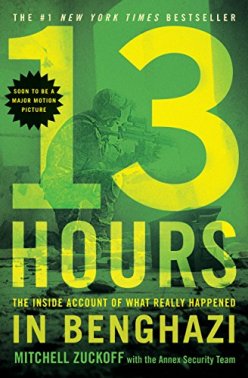
 Because of the highly politicized swirl around ‘what happened in Benghazi’, I expected that a good portion of Mitchell Zuckoff’s narrative would be rooted in Washington.
It is not. Instead, the author works with the surviving members of the Annex Security Team to provide a blow-by-blow account of how the events went down, along with significant and what appears to this reader to be highly responsible interpretation of their meaning in the moment.
Although one can discern a certain casual lethargy ‘back home’, the only person who comes in for consistent derision is ‘Bob’, the on-location CIA base chief who for reasons highly related to his ongoing cellphone conversations would not allow the Annex Security Team to do its belligerent job as soon as the lightly secured U.S. Diplomatic Base in Benghazi—within earshot just a short distance away—was breached with lethal intent.
 moments (precolonial and incipient colonial), set in an African village, scrupulously avoids moralistic evaluation. Instead, the strong but flawed gait of a too proud man carries the reader along though the ambiguities of tribal life and the arrival of a Western-led Christian church.
 I held this little puppy in my hand after about five pencil sharpenings, and I says to myself, ‘Self, this is simple, effective, strong, and European-modern. I bet it speaks German.’
 In the final moments before an overseas move, my wife announced that our Queen mattress and boxspring required a mattress bag.
 We bought these brightly-colored luggage tags when we were moving some of our personal effects from the USA to Colombia, leveraging the availability of cheap, used suitcases to get the job done down and dirty.


 Canter Bridge