By way of his ambitious Living as the People of God (1983), Christopher Wright attempted
to address the paucity of serious reflection on Old Testament ethics by providing ‘a comprehensive framework within which Old Testament ethics can be organized and understood.’ The intervening two decades between the book’s original publication and the 2004 updating of that work as Old Testament Ethics for the People of God had witnessed a florescence of writing on the topic. While the reawakening of popular and scholarly interest in Old Testament ethics is to be welcomed, no part of it lessens the value of Wright’s enduring ‘comprehensive framework’.
Wright has inherited from his mentor, the late John R.W. Stott, the knack for wrestling complexity into clarity without lurching into simplistic reductions. Already in the book’s introduction, we see evidence of this in Wright’s ‘ethical triangle’:
God, Israel and the land—these were the three pillars of Israel’s worldview, the primary factors of their theology and ethics. We may conceptualize these as a triangle of relationships, each of which affected and interacted with both the others. So we can take each ‘corner’ of this triangle in turn and examine Old Testament ethical teaching from the theological angle (God), the social angle (Israel), and the economic angle (the land).
Wright apologizes, even if not fervently, for the absence of the individual that some readers will note in this schema. Yet in this reader’s estimation, that missing individual will show his or her face often enough in the pages that follow, particularly when one is poised at the ‘social angle’ corner of Wright’s admittedly artificial but nonetheless instructive triangle. Continue Reading »
 How does a book like this even happen?
 education emperor has no clothes, it is good to have this little manual from Dorothy Sayers’ pen to provide a well-grounded model of what a real emperor just might look like, fully clothed.
 It is a fortunate and powerful thing moment when a thinker trained for policy analysis finds his voice as a story-teller. That Ian Toll has lent that voice to narrating events in ‘the other war’ is a profound boon.
 is what we used to call a ‘sprawling’ work.
 When a book like Lynn Vincent’s and Sara Vladic’s Indianapolis lies open on lap or desk, a reader sometimes forces himself from page to page. This one does, at any rate.
 deep into two volumes on World War II history, a pair of explanations of Colombia’s unending cycles of political violence (I live in Colombia), and the occasionally disturbing adventure by the late Robert Pirsig so memorably titled Zen and the Art of Motorcycle Maintenance.
 Because my wife and I work as cross-cultural missional servants in Colombia, I was immediately responsive when a dear reading friend recommended this novel, set as it is in our adoptive South American country. It felt a little bit like the reading version of a blind date.
 gentlest spirit, and a deep conviction that God’s care does not flee the human person who finds himself or herself afflicted with dementia. Nor does mercy abandon those who care for the dementia sufferer. I imagine this last group accounts for most readers of this very fine and wisely titled guidebook for one of life’s darker passages.
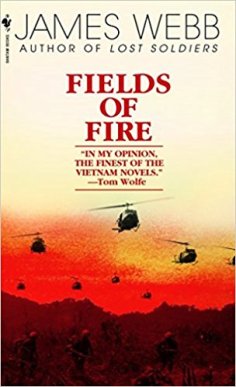 The most astonishing thing about this very good Vietnam novel is that a man who has been a Marine Corps officer, a United States senator (Virginia), and Secretary of the Navy could write it. Seldom in my reading has someone who has both heard the snap of bullets and served in the political apparatus that decides and executes war written a version of events that is so searingly realistic about everything it touches.


 Canter Bridge