Feeds:
Posts
Comments

One of the many paradoxes that the book called Isaiah places before us lies almost hidden in the binary choice that the prophet declares in the book’s eight chapter.

And when they say to you, ‘Inquire of the mediums and the necromancers who chirp and mutter,’ should not a people inquire of their God? Should they inquire of the dead on behalf of the living? To the teaching and to the testimony! If they will not speak according to this word, it is because they have no dawn. (Isaiah 8:19–20 ESV)

It might seem, even to a reader who is committed to the view of things that the biblical text advances, that the choice here is that of living, breathing, even activist religion over against a reliable deposit. That is, between a religiosity that is brewing with live mischief although patently opposed to YHWH’s way over against an orthodox faith that is solid, if a little inert.

It might seem to others, perhaps less inclined to look with favor on ‘what the Bible teaches’, that the most advantageous choice is not exactly an easy one to discern.

Yet the prophet’s language here, upon slow reading and closer inspection, shows that the field of play is not quite so ambiguous. The choice, when things are seen as they are, is not a difficult one to decide.

Here is paradox, indeed, but not much ambiguity.

In fact, the prophet fills the left column of his legal pad with all things deathly, the right with all things alive.

The chirping and muttering of the necromancers, the presumed rumination of the mediums, are for all their apparent vocal dexterity nothing more than death dressed up in the ‘got-your-attention-didn’t-I’ robes of death itself. Isaiah considers the consultation of them a sit-down visit with darkness and decay. People who engage in such doomed conversation ‘have no dawn’.

On the other side of the page, the ‘life’ column fills up with ‘God’, with ‘the living’ themselves, and then—this is where we might stray off course when tracking the prophet’s logic—with ‘the law and the testimony’ and with ‘this word’.

Let’s suppose for the moment that ‘the law and the testimony’ and ‘this word’ roughly abbreviate the accumulated declarations of the prophet in YHWH’s name. More than this is likely insinuated, but we can do without that complication for now.

The prophet aligns these written-down words not with stultifying tradition or a ‘dead letter’, but rather with a God who is very much alive and—the detail is critical—aligned with and active among ‘the living’ who surround the prophet and who are in this terrifying moment scared a little witless.

In the prophet’s view, YHWH has spoken—through him and others—an accumulated deposit of reality that can be declared in street or temple but in awful moments of imminent doom like this one can be written down, consulted, whispered aloud, and treasured.

Far from being inert, we are to understand this ‘law (better, ‘instruction’) and testimony’ as life-containing and life-giving. If other sources of supposed counsel require the dead and lead only to death, this ‘instruction and testimony’ hints at new growth, at fresh eruptions of life, at possibilities still unknown. Though quiet and even silent in this moment, this little reservoir of truth holds the promise of shouting, of dance, of song when the night has faltered and the dawn has come.

If this is how things really are, then why should a people consult the dead on behalf of the living?

Just so.


Our parental angst rises from an inexhaustible well.

We can worry about anything that touches upon our children’s future, and we probably will. We are capable of outlasting any promising fact and every reassuring word.

Yet such fear for our children’s shalom is in pious circles too easily dismissed. Our longing for an ongoing legacy—to put things in the most self-interested way—has itself a long pedigree. And our maternal and paternal desire that children and grandchildren might live long and well is a creational impulse that encourages us against considerable odds to take the long view when après moi le déluge might have seemed the handier parental slogan.

It is telling that the Isaianic redemption song includes a stanza or two for the little ones.

O afflicted one, storm-tossed and not comforted, behold, I will set your stones in antimony, and lay your foundations with sapphires. I will make your pinnacles of agate, your gates of carbuncles, and all your wall of precious stones. All your children shall be taught by the Lord, and great shall be the peace of your children. In righteousness you shall be established; you shall be far from oppression, for you shall not fear; and from terror, for it shall not come near you. (Isaiah 54:11–14 ESV)

Because the prevailing context depicts the construction or re-construction of an enduring city, we should probably read the dual sentence about children as referring both to children as young ones and as offspring now ‘all growed up’.

The doubts of the ‘Afflicted One, Storm-Tossed and Not Comforted’ do not stand alone.

The forlorn cry of the eunuch, that man who is definitionally incapable of both family and legacy, is heard and requited just two chapters away:

Let not the foreigner who has joined himself to the Lord say, ‘The Lord will surely separate me from his people’; and let not the eunuch say, ‘Behold, I am a dry tree.’ For thus says the Lord: ‘To the eunuchs who keep my Sabbaths, who choose the things that please me and hold fast my covenant, I will give in my house and within my walls a monument and a name better than sons and daughters; I will give them an everlasting name that shall not be cut off.’ (Isaiah 56:3–5 ESV)

To say nothing of the brute fact that the very prophetic oracle that lies before us is initiated by the worst fears of a woman who regards herself as childless:

‘Sing, O barren one, who did not bear; break forth into singing and cry aloud, you who have not been in labor! For the children of the desolate one will be more than the children of her who is married,’ says the Lord. ‘Enlarge the place of your tent, and let the curtains of your habitations be stretched out; do not hold back; lengthen your cords and strengthen your stakes. For you will spread abroad to the right and to the left, and your offspring will possess the nations and will people the desolate cities.’ (Isaiah 54:1–3 ESV)

Indeed, it is impossible for the biblical story of redemption to speak singularly for longer than a paragraph or two. Family, clan, tribe, and nation eventually interrupt such relative singularity and resume their central place in the narrative. Only the most stubbornly individualistic reader can rattle on for too long about the solitary man or woman in his or her crisis of faith before finding himself crowded by jostling next of kin.

Some of these are children: those who already cling to at a mother’s breast, those jostling the healthy old folks in restored Jerusalem’s streets, those imagined by a future that suddenly looks like more than smoke and ashes and family trees cut short.

The Isaiah text before us reassures that the wellbeing of the children will grow from the inside out.

All your children shall be taught by the Lord, and great shall be the peace of your children. (Isaiah 54:13 ESV)

All your children will be taught by YHWH, itself an exceedingly broad and unmediated picture of formation and instruction, assures us that truth and reality will have become internalized and therefore organic in the lives of those who may still bear even our name. Perhaps in consequence, their shalom shall root itself deeply and extend to the margins of a remade city, and beyond.

We daddies and mommies find such promise ludicrously unreal. Redemption always looks that way from a distance. Only close up, when YHWH of Wonders has once more shown the meaning of his name, does clarity come clear. Then praise displaces worry, and nearly everything else.


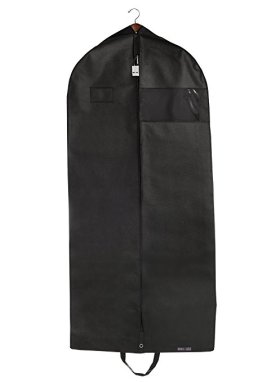
81BoDnpucYL._SY679_After three or four road trips with this very long garment bag, I’m a fan.

My routine with it has not included turning it over to airline baggage handlers. Under these less than rigorous back-seat-of-the-car conditions, I find that the bag exceeds expectations. I can carry significant numbers of shirts and suits, the first choke-point being how many of the protruding hanger-tops I can comfortably handle as I make my way from car to hotel room.

In terms of quality of build and fit-and-finish, the bag represents well-constructed value at a low price point. I estimate it will last me several years for the kind of use I’m describing.

The bag is significantly longer than the average suit, which means it may accommodate dresses or a user who prefers to hang trousers ‘the long way’ rather than bent over a hanger.

Two nice-sized handles at either either hand mean I can bend the bag double, hold both end-handles plus the protruding hanger-heads in one hand, and walk the last ten yards (or one hundred …) to check-in while pulling a suitcase with the other.

Nicely done.

51M8EG+gmgLIf you like Dave Barry’s brand of juvenile humor (as I do), you’ll find this a handy compilation of some of the man’s now quite dated columns.

The reader should self-select. Dave Barry Fans, pick up and read. It’s the same-old same-old, which in this case can be a very *good* thing.

Readers who wish to take their first whack at the Miami-based humor columnist’s work might start with a more recent title.

Still, don’t overthink this. Barry’s guy humor never goes out of style. Just enjoy.

Biblical wisdom probes inconveniently into our multi-tiered strategies for bailing out.

If you faint in the day of adversity, your strength being small; if you hold back from rescuing those taken away to death, those who go staggering to the slaughter; if you say, “Look, we did not know this”— does not he who weighs the heart perceive it? Does not he who keeps watch over your soul know it? And will he not repay all according to their deeds? (Proverbs 24:10–12 NRSV)

Awash in a sea of refugees, newly awake to working-class seething of long standing beyond our earshot, bombarded by raw evidence that racial peace is not the settled shalom we had imagined, it is nice from time to time simply to look away.

The biblical witness follows us to our corners, asking nagging questions.

The wise are toned for the day of adversity, it insists. It is when their memorable work gets done.

Neither does a probing Watcher accept our pleas of ignorance. He discards the defense that we were busy elsewhere.

Where were you when … ? What did you do in that hour … ?

We might have saved some who were staggering to the slaughter.

Oh, here they are again. Through my window, just across the way.


51j-zWJ4EUL._SS300_Evelyn Monahan’s and Rosemary Neidel-Greenlee’s And if I Perish is an exceptional—I am tempted to say ‘must-read’—book for two reasons.

First, the story of U.S. Army nurses in World War II’s European theatre is largely an untold tale. Who knew that these women, for whose work almost no forethought paved the way, played such a critical role in the Allied forces’ campaigns in North Africa and Europe? Once told, the story seems both inevitable and obvious. Yet it is alarming how much one can read about and ponder World War II history without ever giving a thought to the nurses who saved so many lives and provided final comfort to those whose bodies could not be repaired.

Second, the story is told in exceptional style. The authors weave in military strategy in unexpected volume, which provides a welcome context for the self-sacrificing labor of this nearly all-volunteer cadre of frontline nurses. One of the book’s virtues is that it is not a ‘soft’ history over against the ‘hard’ history of soldiers and generals. The result is compelling history and a very fine read.

I purchased and read this book as a small means of honoring the legacy of a nurse from my Pennsylvania hometown who died on the Anzio Beachhead. The poignantly tragic way in which Carrie Sheetz and too many others perished is told movingly in these pages.

Others lived, who perhaps reluctantly and nearly always self-effacingly relieved themselves of the burden they carried in late-in-life interviews with the authors.

The Greatest Generation was comprised of both genders. We have grown to know and honor the stories of the generation’s soldiering men. We are only now learning the deep debt we owe to our mothers and grandmothers. Daughters and sisters belonging to that same generation, they are no less great for the shadow in which they labored, sacrificed, died, and healed.

51-77jM2bAL._SS300_Elizabeth George Speare’s fine novel of a Barbados-born teenager who lands in chilly New England—a bit frosty in more ways than one—makes for fine young adult reading. It was also a treat for this comparative geezer, who will soon live near Wethersfield, Connecticut, the principal location in which this novel’s drama plays out.

I would recommend this novel to any young reader. It packs in enough layers of real life without the added burden of tedious ideological pleading.

Even as it entertains, the book provides a helpful narrative introduction to America’s pre-Revolutionary life in the northeast corner of these colonies and even to some of our once-upon-a-time and enduring political dynamics. Instruction like this goes down sweetly.


teaching Phil: Ephesians 4

There is one in every class.

In my experience, this student is almost always a man, a slightly needy eagerness written across his face from the first minute. His name might be Carlos. Or Abdel. Or Phil.

He talks a lot. Too much, to be honest.

His hand is darting upwards in the middle of too many of my sentences as I try to craft the class, to shepherd a cohort of minds in the same conceptual direction, to establish an environment in which contributions from all parties are welcomed, even expected.

Nervous looks become meaningful glances as Carlos, or Abdel, or Phil speaks up for a third time and a fourth. Then we lose count.

There is a strong argument, advanced most firmly by this student’s fellow students, for shutting him down in the interest of the entire class. The learning experience of all, after all, outweighs the needs of the one to be heard, even to curry favor from the prof.

They have a point. I feel it deeply as Carlos, Abdel, or Phil unconsciously steers the class towards being his own session of self-esteem therapy.

Still, I choose gentle persuasion rather than pulling rank, no matter how just and community-minded the latter approach might sound.

Let me explain.

Carlos makes up his comment as he goes along, not sure at the beginning what he intends to say. Abdel is regularly hindered by a poor upbringing, sometimes involving an absent or belittling father. Phil is a tortured soul, needing someone—it’s even better if a captive audience is listening in—to tell him that he’s doing well, that he’s insightful, that he’s just asked a great question.

But here’s the thing: These guys and their future are not defined by who they are today, in my classroom. In our classroom. They are on their way to something else.

Sometimes it’s a remarkable good place. Even a fruitful place, from which we will be hard pressed to recall the immaturity that is awkwardly evident in my classroom—in our classroom—today.

I’m betting on that future, or at least on allowing it a space to take shape.

This means I’ll pay the political cost in our little class of directing Carlos gently towards an appropriate participation rather than shutting him down, even at the cost of optimal classroom dynamics.

It’s a moment, as I see it, for professorial humility. If that’s a thing.

I take some courage from the apostle Paul’s instructions to the Christian community at Ephesus, which—we might wager—had its own awkward members.

I therefore, a prisoner for the Lord, urge you to walk in a manner worthy of the calling to which you have been called, with all humility and gentleness, with patience, bearing with one another in love, eager to maintain the unity of the Spirit in the bond of peace. (Ephesians 4:1–3 ESV)

I don’t mean to trump all push-back against my classroom logic by quoting Scripture. I just think the shoe fits.

Because, over the decades of teaching and learning—the walls of which are spattered with some spectacularly boring failures and a small, bread-crumbed trail of minor successes—I’ve watched a knot of former students to which Carlos, Abdel, and Phil belong grow into life-long friends, thoughtful writers, and respected leaders.

Who knew?

So I discipline myself, or try to do so, to deal gently with these needy men who could take my best-laid classroom plans with them into a roadside ditch. As best as this sometimes self-absorbed old professor can, I bear with them in love. I see them as they might become, rather than as they quite painfully are.

I risk the class. Indeed, I place their fellow students’ experience at some degree of calculated risk, on that hunch that it may just be worth it.

Someday, Abdel may be in my church’s pulpit, week on week shaping the heart and mind of a community whose weal and woe are my business. I may be devouring every incisive word that Carlos writes. Pastor Phil may stand at my hospital bedside, a steadying presence as my weakening pulse tells family and friends that goodbyes are imminent.

No one will remember, then, their unpromising start.

You never know.


511nu60ABAL._SS300_The concluding section of Tori Bortman’s The Bicycling Big Book of Cycling for Beginners  makes the claim that ‘teaching, bicycles, and writing are Tori Bortman’s passions’. By the time the reader encounters this line, the truth of it has become clear.

Bortman has provided beginner (and, I would say, that face-saving term ‘advanced beginner’) cyclists with a jargon-free, highly readable companion for the first thousand miles on thin rubber tires.

These pages contain no in-house tech talk meant to bolster anyone’s credentials and squeeze the newbies into their corner. Instead, a gifted teacher who really wants her students to love the sport as much as she does builds our understanding from the ground up, step by step, brick by brick, ride by ride.

I’m finishing my first thousand miles and cannot think of a more amiable companion that The Bicycling Big Book for Beginners and the ambitiously empathetic voice it channels to riders whose gasping lungs and pumping legs are just beginning to know their strength.

51kRhvdn8QL._SS300_Leland Ryken’s Words of Delight: A Literary Introduction to the Bible (2nd edition) has endured a longer wait on my reading list that any other book I can recall. Unexpectedly, the book did not meet my long-pent-up expectations.

When offering an unflattering comment on a work that is clearly an authorial labor of love, I owe an explanation. It will without doubt be highly subjective.

Ryken was writing at a time when approaching the Bible first (not to say primarily) as a literary work was not ‘the done thing’ in evangelical circles, which is the ambience from which Words of Delight emerges. There is a polemical note against ‘biblical scholars’, understandable in its moment, that now makes Ryken’s line of approach seem quaint. He can hardly be faulted for writing in and for his moment, so this is an observation rather than a criticism.

More to the point, Ryken appears to this reader to have substituted one lens for another as he peers at Scripture. The lens he has largely laid aside is the historical-grammatical lens, with its concentration on the smaller matters of language and the sometimes myopic probing for history that might lie behind the biblical text. The lens he has privileged is the literary lens, which begins with the assumption that the Bible represents admirable if not breath-taking literary prowess and finds confirmation of this assumption in the reading of it.

Removed from the fracas, we can appreciate that these function best as complementary routes of access to the text, rather than one-or-the-other alternatives.

More importantly, Ryken appears to employ his chosen lens with a certain woodenness. He has not moved from reading the Bible through a fixed paradigm to reading it on its own terms so much as he has substituted a literary paradigm that gives pride of place to the canons of literary genres as these began to be identified in classical literature and have been utilized to interpret (Ryken prefers ‘to explicate’) literature in the modern period. I come away finding that this biblical passage or another has, in Ryken’s hands, been forced into the literary forms that are the pillars and the beams of this approach.

Still, I recommend the book. How so?

It dawned on me late in the reading of Words of Delight that the book is best received as the lecture notes of a gifted professor of English, which is what I suspect they were before being polished for publication. Could it be that I have been the genre-bungler, rather than the author of this love’s labor.

Perhaps.

Read in this way, the 23 chapters that comprise the work’s four sections (‘Biblical Narrative’, ‘Biblical Poetry’, ‘Other Biblical Literary Forms’, and ‘The New Testament’) offer valuable counsel for approaching a certain biblical genre or text in the manner of a competent ‘reader’s guide’.

When I allowed myself to relax and read Words of Delight on these terms, my expectations adjusted. I came away believing that few readers would not be helped by accessing the chapters of this book in such a task-oriented way. Indeed, Ryken—a much loved emeritus professor at a high-standard Christian college—allows this kind of reader the occasional flash of brilliant insight, without the crankiness to which I found descending when seeking the more thrilling panorama.