Feeds:
Posts
Comments

Archive for the ‘reseña’ Category

51rYAIdXH7LThis produce proved to be a high-value solution to our recent moving needs.

Before snagging this ten-pack of moving blankets, we considered renting a similar product from U-Haul. But by the time we rented twice (a near certainty), we’d have spent the money it costs to own these surprisingly high-quality moving blankets.

They arrived in a surprisingly snug package and then kind of sprang to life after I’d done my work on the packaging with a box-cutter.

These blankets exceeded our expectations and quickly made us fans.

Read Full Post »

These days, you don’t have to worry about how to get a giant box spring home. All 45 61JgFrwfoXL._SX522_pounds of this puppy shows up at your doorstep in a compact box that’s easy to carry upstairs and simple to assemble. The latter took me about 30 minutes, using the clear instructions and the included tools. The light aluminum construction distributes the weight of the mattress and the human (OK, maybe the occasional canine) bodies that rest atop it in a way that makes a heavier boxspring unnecessary. The fabric ‘envelope’ zips snugly around the finished metal frame.

I recently assembled a smaller (twin) boxspring that uses wood slats. I prefer this metal assembly by a hair.

Read Full Post »

Jonathan Wilson’s intimate look at this most enigmatic artist is just the introduction a non-specialist like this reviewer needs for moving from a first encounter with Chagall’s work to a deeper understanding of his life and person. I suspect the veteran Chagall watcher will also find more than a little in Wilson’s pages that will enrich his understanding or throw fresh light on ambiguities that are worthy of further inspection.

51Tg6-LCzQLWilson’s method is to follow Chagall around from city to city and lover to lover. Evidence for this is seen in the titles of the book’s seventeen chapters. All but three of them simply present the name of one of Chagall’s places or one of his women. So, for example, ‘1. Vitebsk, 2. St. Petersburg, 3. Paris, 4. Bella … 12. New York, 13. Virgina (Haggard), 14 Orgeval …’ The three exceptions (6. Yiddish Theater, 15. A Problem of Conscience, 17. Blessings) explore matters of deep thematic importance that lie close to the soul of Chagall and his art.

So does Wilson periodize Chagall’s life in helpful ways. We travel with an artist as he moves from context to context in a world where it seemed impossible for him to own any one of them completely or to deny any one finally. Chagall emerges as a conflicted human being, unable fully to rank the places and the people that have shaped him, unable to leave any place behind, certain to live simultaneously as Russian, as Jew, as Frenchman, as quasi-American, as on-again, off-again Zionist, as an artist who was himself never other than a work in progress. (more…)

Read Full Post »

Rarely do I sit down to review a book feeling so conflicted about the thing.

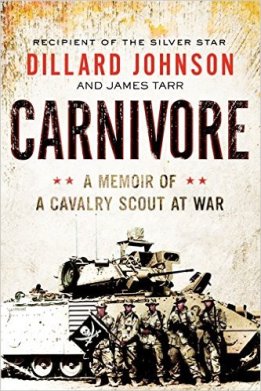
Dillard Johnson’s page-turner puts me in that place. On the one hand, I appreciate the insight into battle as American soldiers have experienced it in Iraq. Carnivore shines light on the extensive planning, the battle tactics, and oscillating adrenaline rush and sheer terror of battle. Because one of my own sons commanded the men in a Bradley Fighting Machine and both have commanded scout platoons, I found that the author’s depiction of armored tactics with the Bradley and the Abrams tank in close coordination made for a fascinating read. This, for me, is where Johnson’s work holds value.61e2tlp4dl-_sx331_bo1204203200_

But there are negatives …

The first one is the nature of Johnson’s claims for his own performance, which has generated bitter resentment on the part of fellow soldiers who believe Johnson has penned an egotistical and inaccurate version of one man’s role in a decidedly team effort. The first-person singular is very frequent in Johnson’s account, not to the point that he does not credit his buddies, but to the extreme that one wonders if the credit is enough. One senses that the author’s better and lesser angels are fighting it out, with the latter winning more often than it should. Despite Dillard’s obvious appreciation of his fellow soldiers, they are pushed to the margins of his record. Arguably, the picture of the fight in Iraq that results is rendered inaccurate by this singular focus.

The second negative is that Dillard’s rhetoric about killing astonishing numbers of Iraqis runs deeply casual. Any prettiness on this front is a first casualty of war—always a flawed and terrible thing—as it should be. On the other hand, ‘Carnivore’ from time to time seems less the moniker given to Johnson’s Bradley than a chosen nickname for the man commanding it.

I find it hard to criticize an American soldier who has left home and family to fight, even more so because I write as the father of two Army officers and the step-father of two long-serving enlisted men. I’m grateful for Dillard Johnson’s service. I’m glad I’ve read the book he’s written about it. I just wish he’d shaped his story into a different one.

Read Full Post »

To read Peter FitzSimon’s Gallipoli is to realize how great an evening it would be to have the man in front of a crackling fire in your living room, telling a good tale.

For it is the telling of a tale that FitzSimon promises us, a tale of how Australia ‘became a nation’ in the wrenching experiencing of bleeding for the British Empire on the hills of the Turkish coast.

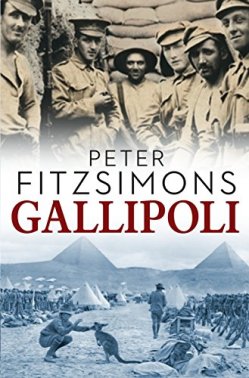
519n8gv6zalFitzSimons puts a lot of himself in this story, not always a promising approach for a history writer. Yet this manages to illuminate rather than obscure the Gallipoli narrative. The author’s full-disclosure explanation of how his own understanding of the battle has changed gives the non-Australian reader a glimpse into the various ways in which that antiopodean nation itself has moved through various stages of engagement with one of its defining moments.

There is little to nothing good to say about a battle of this ferocity, one that concluded with surviving Anzac forces withdrawing to the sea under cover of darkness. But one can at least tell the awful story well. FitzSimons manages to write in—to speak in, for the reader can almost hear his voice—Australian, not a generic academic English.

The result is winsome, savage, feisty (for what is an Australian without a little feist?), and accessible. One emerges from reading this book made wiser not only about the flawed execution of what might otherwise have represented a victorious thrust by the Allied forces into the belly of the Turkish ‘sick man of Europe’, but also more intelligent about how Australian soldiers fought for the mother country’s Empire but died for Australia.

FitzSimons recognizes that many have told the Gallipoli story before him. His contribution is to write, one hundred years on, for Australians and friends of Australians like this reader, several generations hence, when a bit of cool reflection can both enrich and temper our understanding of the passions, ambitions, stupidities, and grit that produced Gallipoli.

A century is long enough for a certain empathy with the enemy of one’s forebears to develop in a way that does not trivialize the complex developments that led a country to war on a land whose name they barely knew. FitzSimons ably captures the privilege of this retrospective distance, not least by recording a recent re-encounter of Turkish and Anzac veterans on this very savage and sacred soil, and by resurrecting Mustafa Kemal’s generous words, penned in 1934:

Those heroes that shed their blood and lost their lives … You are now lying in the soil of a friendly country. Therefore rest in peace. There is no difference between the Johnnies and the Mehmets to us where they lie side by side now here in this country of ours … you, the mothers, who sent their sons from faraway countries wipe away your tears; your sons are now lying in our bosom and are in peace. After having lost their lives on this land they have become our sons as well.

Has it really been a century?

Peter FitzSimon’s fine and well-researched retelling makes it seem just yesterday.

Read Full Post »

One wonders how the course of an epic war takes shape in the remembering mind. It is so easy to move to Normandy and the push across Europe towards Berlin. Yet Normandy and the reconquest of Europe came late in the war and were impossible without the unsung precursors. Like the invasion of Sicily and the hard slog up the Italian boot at a time when it was still possible to underestimate the enemy and, later, convenient to forget places like Anzio and Montecassino.

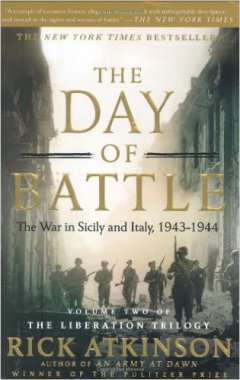
51kz5col-nl-_sx313_bo1204203200_In The Day of Battle, as elsewhere, Atkinson’s writing is not only fueled by the very best research. It also goes down smoothly as such a tale can.

The struggle that had begun in September 1939 was more than half over; yet if both commanders and commanded intuited that they were nearer the end than the beginning, they also sensed that less than half the butcher’s bill had been paid in a bloodletting that ultimately would claim sixty million lives: one life every three seconds for six years. They also knew that if the Allied powers—led by the United States, Britain, and the Soviet Union—now possessed the strategic initiative, the Axis powers of Germany, Italy, and Japan still held the real estate, including six thousand miles of European coastline and the entire western littoral of Asia.

Atkinson exegetes the butcher’s bill as few other military historians can.

In the little Pennsylvania town where this reviewer grew up, twenty-two names adorn the WWII memorial in the main cemetery. Two of these fell in Italy. Curiously, both were women: Carrie Sheetz, a nurse whose station was bombed by a rogue German fighter trying to escape pursuing allied planes at Anzio; and a certain Josephine Strohecker, who perished in Naples.

Atkinson provides a context for understanding such unsought sacrifice on the part of so many citizen soldiers.

This second entry to the Liberation Trilogy is a gift to those who remember the unsung fallen.

Read Full Post »

Henri Nouwen’s A Spirituality of Fundraising is a book I need to read again every year in order to keep my bearings.

415qui41ql-_ac_us436_ql65_My own battle with fundraising has seen some success and some notable failure. I was raised to believe that a decent person never asked anyone for money. Nouwen’s little book turns that idea upside down.

Or, better said, rightside up.

For Nouwen, asking people to become generous and even sacrificial stewards is offering those people the gift of conversion. He means this in the deepest, process-oriented, open sense of the word. Seen this way, it is a service rendered. Ministry extended. I need this.

Nouwen starts strong:

Fundraising is proclaiming what we believe in such a way that we offer other people an opportunity to participate with us in our vision and mission. Fundraising is precisely the opposite of begging. When we seek to raise funds we are not saying, “Please, could you help us out because lately it’s been hard.” Rather, we are declaring, “We have a vision that is amazing and exciting. We are inviting you to invest yourself through the resources that God has given you—your energy, your prayers, and your money—in this work to which God has called us.” Our invitation is clear and confident because we trust that our vision and mission are like “trees planted by streams of water, which yield their fruit in its season, and their leaves do not wither” (Ps. 1:3).

A winsome, God-fueled lightness of spirit pervades Nouwen’s reflection on fundraising, a light-heartedness that is seldom evidenced when this subject is on the table. We are freed, in the best rather than the self-serving sense of the phrase, to be free as we seek funding.

Indeed, Nouwen writes about such in connection with our ultimate security:

If our security is totally in God, then we are free to ask for money. Only when we are free from money can we ask freely for others to give it. This is the conversion to which fundraising as ministry call us.

So it is not only the person receiving our request, but we ourselves who encounter the opportunity of conversion as we go about this work.

I have grown weary of fundraising technique. My soul longs for a gospel-grounded understanding of this otherwise distasteful task.

Nouwen provides it in A Spirituality of Fundraising, this reviewer’s annual reading on the topic.

Read Full Post »

From this reviewer’s, anything with the late David Halberstam’s name on it is ipso facto a worthy read. This aching recounting of a war no one saw coming and nearly everybody forgot is no exception.

51zmq1uhxsl-_ac_us436_ql65_In his introduction to The Coldest Winter, the author alludes to the ‘colossal gaffe’ of Secretary of State Dean Acheson’s omission of South Korea when drawing America’s Asian defense perimeter. Sadly, the Korean Conflict was to offer a strong roster of competitors for ‘greatest colossal gaffe’ status. Per Halberstam’s statistics, the chaotic war without the title would claim 33,000 American lives alongside of 415,000 South Koreans and perhaps a million and a half Chinese and North Koreans.

Of the titans who come off badly, flailingly, blindly, Douglas MacArthur holds pride of place in Halberstam’s telling. The Coldest Winter complements other histories of the conflict by shining a light on an enduring tragedy: the intelligence to understand what the Chinese were willing to sacrifice for control of the peninsula was there to see. Military leaders on what would become a frigid field of battle saw it, often, but could not convince their leadership—particularly egotistic, far-away MacArthur—that it was there, right in front of them.

Halberstam is also merciless with the China hands who in his telling held on far too long to vain hopes that Chiang Kai-Shek was something other than a spent force and that an enduring Communist rule over the mainland China was a fact on the ground that would not be bombed or wished out of existence.

This decidedly non-specialist reviewer found Halberstam’s narrative of ‘the early Kim’ fascinating in light of contemporary developments in North Korea’s ‘Hermit Kingdom’.

A cold winter unfailingly causes an ache in the bones. Perhaps none so deep and enduring as the ache David Halberstam recovers for our consideration and our memory in his masterful The Coldest Winter.

Read Full Post »

I have always appreciated the Rough Guides for their deep research, stunning photography, and urbane matter-of-factness about the places and people that fall under their gaze. A certain British eye on the world and the exploration of it is usually detectable as well, which arguably shortens the distance between the tourist and his or her hosts.

51liskguw4l-_sx324_bo1204203200_The Rough Guide to Colombia is no exception. It may well be the best of its kind for Colombia. Why do I say this?

First, the photography in the Kindle format I own just pops on my iPad.

Second, Stephen Keeling has a knack for capturing a whole complex of reality in a single, well-crafted sentence or two. His very first lines of introduction prove the point.

One of the world’s most infamous but misunderstood countries, Colombia boasts a rich history and an incredibly diverse array of attractions, from soaring Andean peaks smothered in cloud forest to palm-fringed Caribbean beaches and gorgeous colonial cities such as Cartagena.

But this ability is sustained throughout the book. Allow me a few more examples:

Colombian food is hearty and filling rather than spicy or exotic (although they do spice it up a bit more on the coast) …

For all its instability and upheavals, Colombia has a strong and robust tradition of press freedom, and as befits a country with 94-percent literacy, a wide range of newspapers and magazines … Colombian newspapers tend to be regional rather than national … Although the press is in principle free, and papers express a wide range of views, press owners tend to be closely tied to political interests—indeed, some are active politicians …

Colombia is a tropical country, where germs breed fast, but it’s also a country where hygiene is generally good, and most travellers who come here catch nothing more serious than a dose of the runs, if that …

The same sense for brevity without reductionism is found in the book’s helpful ‘Fact Files’, which are eccentric without being cute.

Again, one-offs like ’21 Things Not to Miss’ touch upon a wide range of Colombia’s virtues without kowtowing to any narrow line of interest.

Third, Keeling invests a substantial number of pages to the basics of traveling to, through, and out of Colombia. He neither moans about Colombia’s violent past nor naively whistles past current risks that must be thoughtfully addressed.

Fourth, the research that has gone into this guidebook is both broad and deep. A reader could spend a lifetime in Colombia and not exhaust the practical counsel that Keeling offers here.

Most, however, will not spend that lifetime in Colombia. A week or two is more likely. In this light, one of the standards to which I hold a purported guidebook takes the form of a question: ‘Would a citizen of the nation that is being introduced say, “Yes, the author has understood us and our place?” I believe a Colombian reader would likely judge that Keeling has done so.

The Rough Guides in general are the guidebook line to beat. If I were to take only one guidebook to Colombia, Stephen Keeling’s Rough Guide would be the one.

Read Full Post »

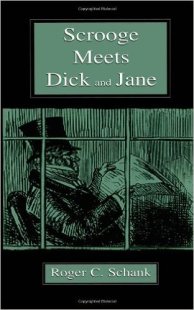
Roger Schank’s hilarious send-up of Charles Dickens’ A Christmas Story has all manner of respect for Dickens and even for the original Scrooge. In fact, Schank dedicates the book to Dickens.

51g54pbkdql-_sx310_bo1204203200_It is the practitioners of education-as-preparation-for-test-taking who absorb the blows of the author’s satire. The Yale University Admissions Department and the Educational Testing Service stand in for the broader industry.

Schank’s Scrooge, the businessman behind the Scrooge Testing Service, is forced to reckon with four nocturnal spirits. First comes the Ghost of John Dewey to illuminate the aged educational tester about the ordeal he must bear, then the Spirit of Education Past, the Spirit of Education Present, and the Spirit of Education Future. In real life one of America’s educational icons, Dewey had been Scrooge’s teacher at Columbia and had once lived in Scrooge’s apartment. But that was a long time ago and so very much forgotten.

I found myself chuckling throughout my reading at the turns Schank executes on his Dickensian framework. Satire achieves its success when it makes the status quo seem ludicrous. In this sense, Scrooge Meets Dick and Jane achieves its goal.

Satire becomes fun when it smartly juxtaposes an old and familiar reality with the new thing that is being ridiculed.

Dickens’ Scrooge awakens from his troubled sleep to throw open a window and announce by word and deed to the world below that he gone from being a curse upon it to a blessing. Schank’s Scrooge follows in stride. Let the remaking of a familiar scene stand in for the whole enterprise:

‘What’s happening today?’, cried Scrooge, calling downward to a boy, who perhaps had loitered in to look about him.

‘Eh?’ returned the boy, with all his might of wonder.

‘What’s today, my fine fellow?’ said Scrooge.

‘Today?’ replied the boy. ‘Why today is the day when the SATs are administered.’

‘I haven’t missed it.’ said Scrooge to himself. ‘The Spirits have done it all in one night. They can do anything they like. Of course they can. Of course they can. Hallo, my fine fellow!’

‘Hallo!’ returned the boy.

‘Run to the school and tell them not to administer the exam,’ Scrooge replied.

‘What? Why would they listen to me? No one could stop the exam. Besides the exam is being given all over the country in every school,’ replied the lad.

‘An intelligent boy!’ said Scrooge. ‘A remarkable boy! You are absolutely correct! I must call the newspapers. I must post something on our web site. I must get on television!’

‘What will you tell them?’ returned the boy.

‘That there will be no more exams. Scrooge’s Testing Service is going out of business,’ said Scrooge. ‘It will be a pleasure to talk to them. Yes, my buck.’

‘But they will demand a replacement,’ replied the boy. ‘How will they know how I am doing in school? How will they know who is getting it and who is not?’

‘They will have to do what they did before there were testing services,’ said Scrooge. ‘They will have to pay attention to each individual child. Yale will have to interview its applicants and listen to the opinions of teachers. They will have to seek out original minds instead of good test takers!’

‘Surely you jest!’ exclaimed the boy.

It is principally educators who will pick up Scrooge Meets Dick and Jane. No matter their educational philosophy, they will find something of themselves in Roger Schank’s satire. It may even enliven discussion which all to often is dry, arcane, and a country mile from anything as imaginative as Charles Dickens and that other Scrooge story.

Read Full Post »

« Newer Posts - Older Posts »