One wonders how the course of an epic war takes shape in the remembering mind. It is so easy to move to Normandy and the push across Europe towards Berlin. Yet Normandy and the reconquest of Europe came late in the war and were impossible without the unsung precursors. Like the invasion of Sicily and the hard slog up the Italian boot at a time when it was still possible to underestimate the enemy and, later, convenient to forget places like Anzio and Montecassino.
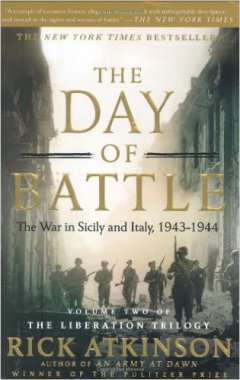 In The Day of Battle, as elsewhere, Atkinson’s writing is not only fueled by the very best research. It also goes down smoothly as such a tale can.
The struggle that had begun in September 1939 was more than half over; yet if both commanders and commanded intuited that they were nearer the end than the beginning, they also sensed that less than half the butcher’s bill had been paid in a bloodletting that ultimately would claim sixty million lives: one life every three seconds for six years. They also knew that if the Allied powers—led by the United States, Britain, and the Soviet Union—now possessed the strategic initiative, the Axis powers of Germany, Italy, and Japan still held the real estate, including six thousand miles of European coastline and the entire western littoral of Asia.
Atkinson exegetes the butcher’s bill as few other military historians can.
In the little Pennsylvania town where this reviewer grew up, twenty-two names adorn the WWII memorial in the main cemetery. Two of these fell in Italy. Curiously, both were women: Carrie Sheetz, a nurse whose station was bombed by a rogue German fighter trying to escape pursuing allied planes at Anzio; and a certain Josephine Strohecker, who perished in Naples.
Atkinson provides a context for understanding such unsought sacrifice on the part of so many citizen soldiers.
This second entry to the Liberation Trilogy is a gift to those who remember the unsung fallen.
 My own battle with fundraising has seen some success and some notable failure. I was raised to believe that a decent person never asked anyone for money. Nouwen’s little book turns that idea upside down.
 In his introduction to The Coldest Winter, the author alludes to the ‘colossal gaffe’ of Secretary of State Dean Acheson’s omission of South Korea when drawing America’s Asian defense perimeter. Sadly, the Korean Conflict was to offer a strong roster of competitors for ‘greatest colossal gaffe’ status. Per Halberstam’s statistics, the chaotic war without the title would claim 33,000 American lives alongside of 415,000 South Koreans and perhaps a million and a half Chinese and North Koreans.
 The Rough Guide to Colombia is no exception. It may well be the best of its kind for Colombia. Why do I say this?
 It is the practitioners of education-as-preparation-for-test-taking who absorb the blows of the author’s satire. The Yale University Admissions Department and the Educational Testing Service stand in for the broader industry.

 The Medellín Travel Guide‘s strength is that its author has followed the people of the city he surveys in putting Medellín’s regrettable notoriety firmly in his rear view mirror. Though Lee references the bad old days when the city writhed under the rule of its drug lords—and even places the Pablo Escobar Tour first on his list of ‘Top Nine Things to Do’—he clearly loves Medellín as it is today. His enthusiasm is catching.


 Canter Bridge