In short order Yohanna Katanacho has established himself as a thoughtful and reliable member of an extraordinary cluster of theologians who gather around Bethlehem Bible College. In The Land of Christ. A Palestinian Cry, Katanacho allows us a glimpse into the remarkable events in his own life that have made love towards all, even towards one’s enemy, his core alignment. One might even say that Katanacho’s personal narrative, which occupies the first part of the book and helpfully frames his subsequent argument about the land, drains the word ‘enemy’ of its acid. In the context from which the author writes, this is no small accomplishment and should not be confused with passivity in the face of the cruelest of facts.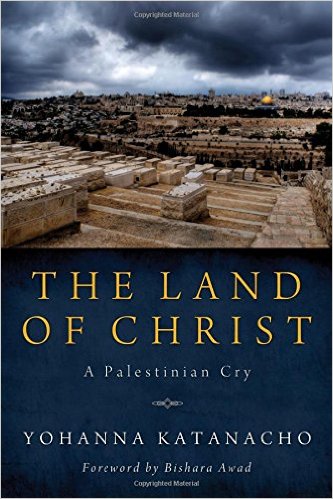
Katanacho proposes ‘Three Important Questions’:
√ What are the borders of the land?
√ Who is Israel?
√ How did God give Israel the land?
Exploring a wide range of biblical passages that are often adduced to establish the modern state of Israel’s divine right to the contested space it claims, the author argues that there is a fluidity in biblical definition both of the land and of Israel. Additionally, there is a contingency in the giving of the land that makes its possession subordinate to a God-given purpose and to the ethic with which it is held. Finally, the author asserts that New Testament revelation considerably reframes the question of the land in ways that make naive citation of Old Testament texts by Christians problematic.
To his credit, Katanacho never ceases writing as a Palestinian Christian believer. The reader who will be most persuaded by his argument is the English-speaking Christian who has imagined that his or her theology provides clear and simple affirmation of the contemporary status quo. Katanacho asks this reader both to think again and to think in the light of a reasoned Christian theology of the land.
Additionally, Katanacho moves beyond the language of victimization, a courageous act in his context. Even as he writes assertively against what he can only recognize as ‘Israeli occupation’ of land that prior to 1967 belonged to others, he recognizes that all—Palestinians, Jewish Israelis, Muslims, Christians—are complicit in a situation that makes imposition and violence the default behaviors in this contested arena. Love supplants this hateful status quo usually or even only as it flows from encounter with the cross of Christ. Importantly, Katanacho does not believe a solution to the current impasse over the land’s possession will occur soon, probably not in his lifetime. Yet he holds on to the hope that it will come eventually, and he writes this work as a ‘Palestinian cry’ for disciplined, non-violent, and loving conduct (even when this conduct is ‘resistance’) in the meantime.
As is common to circles of theologians who lack the luxury of doing theology at a distance from painful and pressing realities, Katanacho is attentive to how ‘having the right theology’ changes hearts, minds, and facts on the ground. An extended quote is in order, not least for its exquisite distinction between ‘eschatacentric’ and ‘Christocentric’ eschatologies.
(H)aving the right theology transforms our psychology. The term ‘theology’ is not only associated with orthodoxy (right doctrine) and orthopraxis (right practice) but also with orthopathos. Orthopathos is the kind of human suffering that becomes a source for liberation and social transformation. In his suffering, the Psalmist thought that God had forgotten him (Ps 42:9) and even rejected him (Ps 43:2). But in fact, his ordeal make him thirst for God and promoted him to pour himself into prayer … This leads us to the second insight: having the right theology, or more specifically the proper view of God, alters the focus of our eschatology. God speaks in and through our pain. In effect, he is transforming the pain of Palestinian refugees into a divine message that reminds the world of the difference between heartless or hardhearted eschatacentric eschatology represented by some Christian theologies and merciful Christocentric eschatology. The former focuses on ‘God’s agenda’ or the so called prophetic programs, while the latter reveals God’s heart and nature.
The final chapter includes the author’s lightly retouched version of ‘The Palestinian Kairos Document’, a Christian manifesto that is worth the price of this book.
This reviewer suggests reading The Land of Christ alongside Colin Chapman’s Whose Promised Land?.


 Canter Bridge
Leave a comment