Parker Palmer’s graceful little book Let Your Life Speak is the best work I’ve ever read on discernment and vocation.
In six chapters and just under 120 elegantly written pages, Palmer presses home the point that vocation emerges from within us and that we must listen carefully to our own lives if we are to discover it. Taking on someone else’s concept of calling or subjecting ourselves to an external and alien set of values and objectives will do violence to ourselves and to our usefulness—Palmer would probably avoid the word—to our community and our world. Throughout, the author’s rooting in Quaker patterns and rhythms is evident, but this book is anything but sectarian and will be welcomed—indeed, has been welcomed, for it was published in the year 2000—by readers of many faiths and perhaps of none.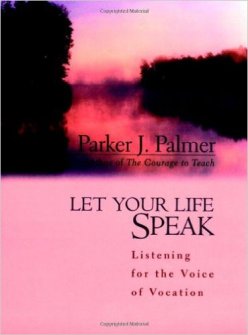
Chapter I, ‘Listening to Life’, argues that one’s life is worthy of study and profoundly worth listening to. ‘The soul is like a wild animal—tough, resilient, savvy, self-sufficient, and yet exceedingly shy. If we want to see a wild animal, the last thing we should do is go crashing through the woods, shouting for the creature to come out. But if we are willing to walk quietly into the woods and sit silently for an hour or two at the base of a tree, the creature we are waiting for may well emerge, and out of the corner of an eye we will catch a glimpse of the precious wildness we seek.’
In his second chapter (‘Now I Become Myself’), Palmer initiates in earnest the autobiographical transparency that he will sustain through the book, lending to his lines an authenticity that is arguably their most compelling feature. After having tried and failed over several episodes to forge a sense of vocational and personal identity, Parker writes that …
‘(t)oday I understand vocation quite differently—not as a goal to be achieved but as a gift to be received. Discovering vocation does not mean scrambling toward some prize just beyond my reach but accepting the treasure of true self I already possess. Vocation does not come from a voice “out there” calling me to become something I am not. It comes from a voice “in here” calling me to be the person I was born to be, to fulfill the original selfhood given me at birth by God.’
The author urge us not to ‘wear other people’s faces’ and to realize that ‘(t)he deepest vocational question is not “What ought I to do with my life?” It is the more elemental and demanding “Who am I? What is my nature?”.’
Yet Palmer does not imagine that this discovery of one’s true self occurs often without pain. ‘Most of us’, he avers, ‘arrive at a sense of self and vocation only after a long journey through alien lands … before we come to that center, full of light, we must travel in the dark. Darkness is not the whole of the story—every pilgrimage has passages of loveliness and joy—but it is the part of the story most often left untold.’
This ultimate qualifier is another item that, to this reader’s ears, lends the ring of truth to Palmer’s adventure. I say this because my own journeying after true vocation has, like Palmer’s, led me through both sunlight and darkness, yet I cannot say that any of the miles traveled has been entirely dark or entirely bleak, and certainly not entirely regrettable. Unlike many more mechanical treatments of the topic, Palmer’s notion of vocational discovery leads him to value the path rather than merely the destination.
One finds, in this second and longest of Palmer’s chapters, refreshingly important roles to be played by fear, failure, and ordinariness. In my view, this makes Let Your Life Speak accessible to those of us who resonate with Palmer’s journey but could never write so elegantly of our own.
Chapter III is titled ‘When Way Closes’. The missing article is not a typo, but rather a nod to the Quaker sense of ‘Way’. In the discourse of the Friends, we learn, ‘way opens’ and ‘way closes’. Palmer traces a givenness to vocation, a created anchoring in our persons that does not make all things possible. Instead, the way each of us is both opens doors and closes doors. Sometimes the closing brings embarrassment and shame.
It would be nice if our limits did not reveal themselves in such embarrassing ways as getting fired from a job. But if you are like me and don’t readily admit your limits, embarrassment may be the only way to get your attention. I go on full alert only when I am blocked or get derailed or flat-out fail. Then, finally, I may be forced to face my nature and find out whether I can make something of both my gifts and my limitations. (emphasis added)
Palmer develops the role played by our limitations by counterposing the ‘oughts’ that we often heed in our vocational adventure to the ‘ecology of life’ in which we find a proper place to stand and to be. In this third chapter, this Christian reader finds the theological undergirding to Palmer’s prose that the author often touches upon only lightly. It is, for Palmer, the ‘God of reality’ who ‘dwells quietly in the root system of the very nature of things’. He speaks easily of ‘one’s created nature’. When one finally comes to rest within this ecology burnout is not the inevitable outcome of passionate labor. Rather, ‘(w)hen the gift I give to the other is integral to my own nature, when it comes from a place of organic reality within me, it will renew itself—and me—even as I give it away.’
‘All the Way Down’ (Chapter IV) suggests that an excruciating read likes just ahead and the title does not deceive, for in this fourth chapter Palmer sketches out for us his two debilitating experiences of depression. Neither reducing nor simplifying the causes of depression—in fact he calls the thing a ‘mystery’—Palmer managed in his own suffering to find his way to viewing depression as his friend. It took him all the way down to where it was safe to stand. Following upon his previous description of ‘the God of reality’, Parker borrows Tillich’s description of God as the ground of being.
I had always imagined God to be in the same general direction was everything else I valued: up … I had to be forced underground before I could understand that the way to God is not up but down.
Thankfully, Palmer does not write prescriptively about the ways (plural) into depression nor the ways (again, note the plural) out. His own recovery remains something of a mystery, captured in the magnificent poem with which he graces the conclusion of Chapter IV. Yet for him, his submission to the vocational ‘oughts’ by which he permitted himself for years to be hounded prepared the way down into the darkness. There he found not only God, but himself as well.
Chapter V (‘Leading from Within’) now turns outward to the damage and the health that a leader can bring to the wider community and, indeed, to the world. We project both shadows and light onto the world. ‘A good leader is intensely aware of the interplay of inner shadow and light, lest the act of leadership do more harm than good.’
In this chapter, any hint that vocation is essentially a narcissistic pursuit evaporates. For Palmer, vocation begins within but eventually projects itself onto one’s world. He writes insightfully of the ways leaders fashion a community from misguided starting points and, happily, also via the freedom that comes from authentic vocation. Let me single out at some length a few of Parker’s words on fear as motivator:
As one who is no stranger to fear, I have had to read those words with care so as not to twist them into a discouraging counsel of perfection. “Be not afraid” does not mean we cannot have fear. Everyone has fear, and people who embrace the call to leadership often find fear abounding. Instead, the words say we do not need to be the fear we have. We do not have to lead from a place of fear, thereby engendering a world in which fear is multiplied.
We have places of fear inside of us, but we have other places as well—places with names like trust and hope and faith. We can choose to lead from one of those places, to stand on ground that is not riddled with the fault lines of fear, to move toward others from a place of promise instead of anxiety. As we stand in one of those places, fear may remain close at hand and our spirits may still tremble. But now we stand on ground that will support us, ground from which we may lead others towards a more trustworthy, more hopeful, more faithful way of being in the world.
This reviewer—like Palmer, no stranger to fear—thrills to such a sound and realistic assessment of the kind of ‘fearlessness’ that embraces reality and yet dares to lead, unparalyzed.
In his concluding chapter (VI, ‘There is a Season’), Palmer departs from his now familiar approach to speak of how ‘the quest for selfhood and vocation’ follow the recurring patterns and rhythms of the four seasons. This chapter alone would justify keeping Let Your Life Speak within arm’s reach, to be read and re-read at the calendar’s and the seasons’ turnings.
One can hardly read Palmer’s exceedingly transparent work on vocation and then write for others about it without a bit of transparency of his own. After twelve years of leadership in a relatively prominent position—at least for the proportions of this reviewer’s little world—I recently hit the wall at the end of a particularly grueling vocational mile. This is not without its emotional violence, its sense of failure and disillusionment, its return to the root considerations of vocational identity, and its forceful requirement to look again and to look within for wisdom about next steps. For me, each page of Palmer’s Let Your Life Speak brought both balm and direction. Many brought exhilaration as well.
I offer this review in hopes that Palmer will be a bit more widely read for those, like me, who find a wise mentor the doctor’s very order.


 Canter Bridge
Leave a comment